
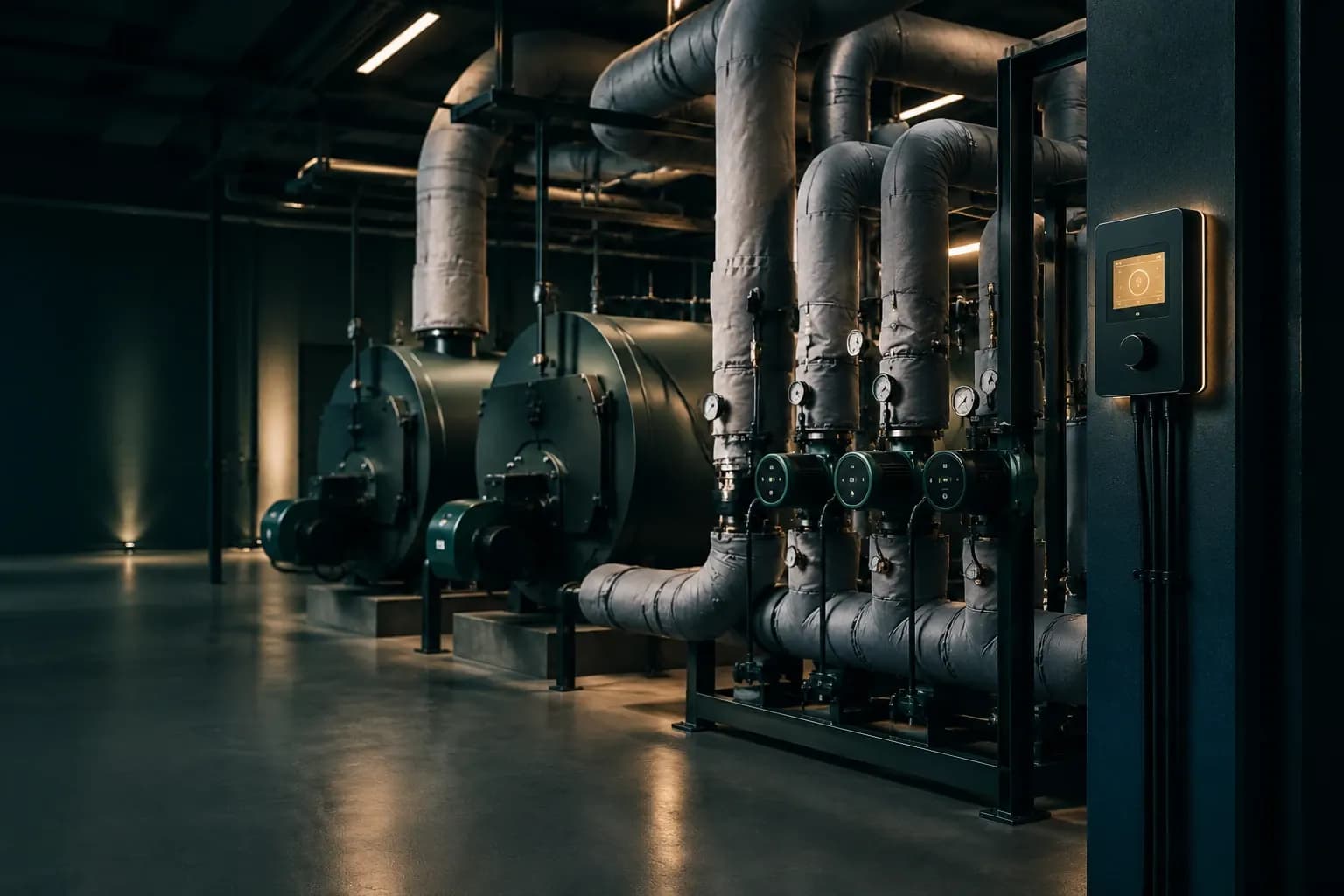
What is a smart powerhouse system?
Runs the boiler plant from outdoor temperature, the real temperature of each zone and the building's occupancy schedule, moving fuel consumption from "always on" to demand-driven.
Why this monitoring is needed
A conventional boiler room runs on one thermostat and on/off logic. That produces two errors at once: on mild days it makes more heat than the building needs, and in hard frost the same system is slow to reach setpoint. Neither appears separately on the bill; only their sum shows up as "the gas cost".
The second error is timing. Offices, schools and mosques have very clear occupancy patterns, yet the plant usually holds the same setpoint around the clock, because nobody is there to turn it down each night and up each morning. The biggest saving in these buildings is not new equipment — it is switching off the existing equipment at the right time.
Fidar's smart powerhouse control has been through four generations: the first (2003) with linear control from outdoor temperature; the second (2011) with non-linear pump control on five digital sensors; the third (2014) adding monitoring over the local network; and the fourth (2019) bringing IoT/IIoT connectivity over Modbus and LoRa, with any number of systems managed centrally from one dashboard.
What gets measured
Outdoor temperature
The basis of the compensation curve: flow temperature becomes a function of outdoor temperature instead of a fixed number.
Flow and return temperature
The flow-return differential shows boiler efficiency and whether water is really circulating; a narrow gap means an over-pumped, under-performing system.
Zone temperature
Several points across floors and façades; the south and north sides are never at the same temperature and one thermostat cannot satisfy both.
Pump and burner operation
Motor current and the burner's dry contact prove what is actually running; a pump with power that is not turning is invisible from outside.
Domestic hot water temperature
The DHW cylinder has its own schedule and setpoint, separate from the heating circuit; holding it at the right temperature is both a hygiene and a cost matter.
Plant room water leaks
Sensing cable on the plant room floor catches a leaking valve or exchanger before it reaches the electrical panel.
Recommended equipment
Every model below is from the Fidar Electronics range. The final combination is set after a site survey or an engineering consultation.
FCH3256-01
FCH3256-01
Smart powerhouse controller with network connectivity, for a building with a local network
FCM3256-01
FCM3256-01
GSM version for buildings with no network — control and alarms over the mobile line
FCM3256-02
FCM3256-02
Compact, economical version for small and mid-size buildings

FTD3070-01
Spot Temperature Sensor
Spot temperature sensor for flow, return and the DHW cylinder
View product ←
FTA3070-01
Temperature and Humidity Sensor
Temperature and humidity sensor for building zones and outdoor air
View product ←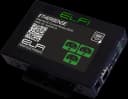
FAC2000-23
3-Channel Networked AC Current Sensor
3-channel AC current sensor for pumps, burner and air handler
View product ←
FDD0001-02
3-Channel Dry Contact Detector
3-channel dry-contact detector for burner status, boiler alarm and the emergency switch
View product ←
FAC0420-01
4–20 mA Current Sensor
4–20 mA input for circuit pressure and cylinder level transmitters
View product ←
FDW0050-01
Water Leak Sensor
Water-leak sensor on the plant room floor
View product ←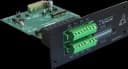
FDR0508-01
FDR0508-01 8-Channel Relay Output Card
8-channel relay card commanding pumps, burner, motorised valves and the air handler
View product ←Alarm and automation rules
- 1
Flow temperature is computed from the outdoor-compensation curve rather than held at a fixed setpoint.
- 2
Scheduled night and holiday setback, with an optimum-start pre-heat so the building reaches setpoint the moment people arrive.
- 3
Pump current lost while the burner is firing: burner stopped by relay and an immediate alarm — the boiler is at risk of boiling dry.
- 4
One zone running below target while its circuit is active: zone valve or pump alarm.
- 5
Any water on the plant room sensing cable: immediate SMS to the facilities manager.
- 6
Monthly burner and pump running-hours report, as the baseline for comparing consumption before and after.
What the operator gets
Fuel use falls once the excess heat of mild days and empty hours is removed.
Complaints about cold and hot zones are settled by seeing each zone's real temperature instead of guessing.
A pump or burner failure is announced as it happens, not once the building has gone cold.
An organisation's buildings are compared on one dashboard, and the wasteful one becomes obvious.
Frequently asked questions
What exactly is the difference between a conventional and a smart plant room?
A conventional plant room runs on a thermostat and on/off logic with no feedback from the building's zones. A smart one uses a controller and distributed sensors to set flow temperature from outdoor conditions and real internal demand, follows a schedule with night setback, and records what each item of plant actually did. The practical difference shows up on the bill, not in how the room looks.
Which controller suits our building?
If the building has a local network and you want central control, the FCH3256-01. If there is no network, or you would rather not depend on it, the FCM3256-01 handles control and alarms over the mobile line. For smaller buildings with fewer points, the FCM3256-02 is the economical choice. The final decision follows the zone count, the number of pumps and how remote access is expected to work.
Can it be retrofitted, or does everything have to be replaced?
It is a retrofit. The boiler, burner, pumps and heat exchanger all stay; what is added is the controller, the temperature sensors and the relay outputs. In most projects the existing plant is neither weak nor worn out — it is simply running without data.
How much does it save?
The real figure depends on where the building starts from and cannot honestly be promised without data. The largest share usually comes from two places: removing excess heat on mild days through the compensation curve, and scheduled shutdown in empty hours. That is why a monthly running-hours report is part of the system — so the saving is measured rather than claimed.
Related solutions
Want this solution on your own site?
Send us the site details and we will put together the equipment list and a technical proposal to match.